Carbon filters.
Activated carbon addresses chlorine taste and odor. What else a filter can reduce depends on its media, design and contact time.

A LITTLE CURIOSITY. A LOT MORE CLARITY.
From your first shower to your morning coffee.
See what happens inside—and why each part matters.
Conceptual illustration. Media placement, proportions and cycle steps are simplified.
1 OF 4 · THE EVERYDAY ROUTE
Open a faucet and water moves through the treatment tank before reaching the connected fixtures in your home. Carbon and resin work in the same tank, for different reasons.
Everyday household flow does not travel through it. Its job comes later.
Nothing here controls equipment. Want the words without the motion? Read the essentials ↓
THREE JOBS. ONE CLEARER PICTURE.
Knowing the difference makes choosing a system much simpler.
Activated carbon addresses chlorine taste and odor. What else a filter can reduce depends on its media, design and contact time.
Ion-exchange resin removes hardness minerals that contribute to scale. It exchanges ions; it does not turn water into pure H₂O.
A membrane reduces many dissolved substances at a dedicated kitchen tap. A separate drain stream carries the concentrated remainder away.
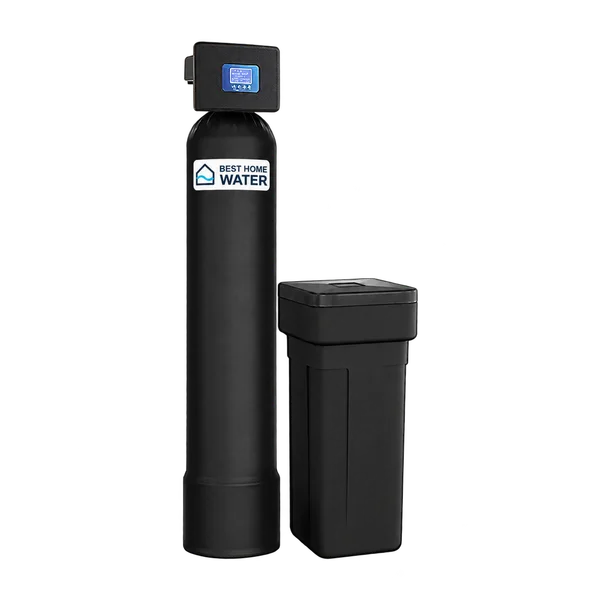
MEET THE SYSTEM BEHIND THE STORY
Our Standard Softener + Filtration brings coconut-shell activated carbon and 10% crosslinked resin together, with a separate salt tank for regeneration.
Pair it with our seven-stage tankless RO for a dedicated kitchen drinking-water tap. We confirm the right fit for your water, home and installation.
THE QUESTIONS BEHIND THE EQUIPMENT
Clear answers you can come back to.
Yes. Our Standard Softener + Filtration combines activated carbon and ion-exchange resin in one treatment tank. They perform different jobs: carbon addresses chlorine taste and odor, while resin reduces calcium and magnesium hardness. The smaller salt tank supports resin regeneration; it is not a second everyday filtration stage.
Filtration targets substances that a particular filter or medium can reduce. Softening specifically removes hardness through ion exchange. Carbon does not soften water, and a softener does not remove every dissolved substance. Combining the two can address different concerns in the same home.
Salt dissolves in the brine tank to make a concentrated solution. During regeneration, that brine restores the resin’s ability to exchange hardness ions. The used brine and released hardness go to a drain, followed by rinsing. Salt does not replenish the carbon’s filtration capacity.
No. In normal service, household water travels through the treatment tank, not through the salt storage tank. A sodium-based softener does add sodium through ion exchange; how much depends on the hardness removed. That is different from sending regeneration brine to your faucets.
The Standard system uses demand-initiated regeneration: the controller tracks water use against its programmed capacity. Hardness, household use and controller settings affect timing. Its regeneration is specified as upflow, opposite the normal service direction. The animation simplifies the process and is not a valve-programming guide.
Not necessarily. A softener exchanges hardness ions for other ions rather than removing all dissolved solids. A handheld TDS meter cannot verify that your water is soft, identify individual contaminants or prove water is safe. Use a hardness test for softening performance and appropriate water testing for other concerns.
Kitchen RO performs a different job. A membrane separates a portion of the feed water into drinking water with fewer dissolved substances and sends a concentrated stream to the drain. The dedicated drinking faucet serves cooking and drinking; it does not supply every fixture. Reduction performance depends on the particular system and water conditions.
It means the RO system does not use a separate drinking-water storage tank. Our seven-stage tankless option includes alkaline remineralization. This page illustrates the core RO separation process, not an unverified seven-cartridge sequence. Explore the product page for published specifications and installation considerations.
Check salt levels and replenish with the recommended salt. Carbon eventually needs replacement, and resin and the control valve need condition-based attention. RO filters and membranes also need replacement. Your water, usage and selected equipment determine the care schedule; regeneration does not make every component last indefinitely.
Start with the water source, measured hardness, household demand and the concerns you want to address. Chloramine, private-well water, iron and other conditions may call for different media or additional treatment. This Standard-system illustration is not a universal treatment plan or a disinfection system.
LET’S MAKE IT PERSONAL
Tell us what you notice in your water.
We’ll help you connect the dots.
Serving Central Florida. Equipment and installation confirmed for your home.